

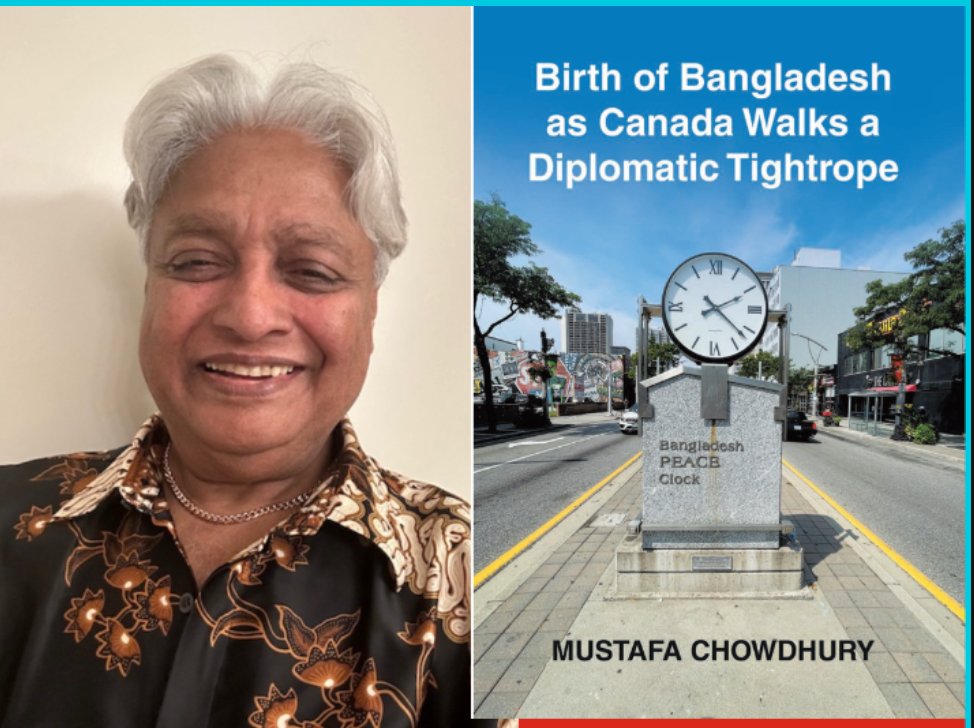
Birth of Bangladesh as Canada Walks a Diplomatic Tightrope
The period analyzed is the crisis phase, beginning with the military crackdown on March 25, 1971, and ending with the Pakistani army’s surrender on December 16, 1971. My goal was to document Canada’s role in the liberation war by examining government and non-government documents available in Canadian archives. This study examines the actions and responses of the Canadian government, Canadian NGOs, Canadian media, and the Canadian public. It details Canada’s support for victims of the military crackdown and its mediating role. Finally, it highlights their respective positions regarding the conflict involving the military government of President Aga Muhammed Yahya Khan, the Provisional Government of Bangladesh, and the government of India.
Because Canada is deeply tied to its collective historical experiences, its initial reaction is difficult to pin down. Unlike the Nixon administration, which openly supported the Pakistani military government led by President Yahya, the government led by Pierre Elliott Trudeau hesitated due to Canada’s foreign policy constraints. As ongoing military reprisals forced millions of Bengalis to flee, Canadians began pressuring their government to clarify its position. With the help of the Canadian High Commissioners to Pakistan and India, External Affairs Minister Mitchell Sharp and his team began focusing on developments in the Indian subcontinent. Members of Parliament (MPs) began challenging the government, demanding greater transparency in its public stance to reflect Canadians’ wishes.
In the House of Commons, the government faced a barrage of questions: Was the military takeover and crackdown a violation of the democratic rights of the people of Pakistan? Should democracy be upheld under all circumstances? Should President Yahya continue his military reprisals in East Pakistan, since Pakistan’s integrity was at stake? Should power be transferred to the elected leader of East Pakistan, regardless of the military government’s opinion of the leader of the majority party? There were no clear answers, as the rebel forces’ declaration of independence and the formation of the Provisional Government of Bangladesh in India had already added another layer of complexity to the issue of transferring power to the leader of East Pakistan. Amid the domestic crisis, what was India’s role? Was India drawn into the crisis by the influx of refugees? What role should Canada play as a senior member of the Commonwealth for the two Commonwealth nations at war since the 1947 Indian partition?
At that time, the Trudeau government was grappling with one of the most critical issues in its own backyard, the October Crisis of 1970. The government was still assessing the impact of the War Measures Act’s declaration following the FLQ (Front de libération du Québec) crisis of 1970. As a result, it was especially cautious about condemning Pakistan’s central government for intervening in its “internal affairs.” At times, Canada believed the scale of the human tragedy was much greater than it initially appeared. At other times, the Trudeau administration believed that, from a humanitarian standpoint, any intervention under those circumstances might have been considered legitimate. Canada found itself between a rock and a hard place, especially as debates around the world continued immediately after millions of Bengalis fled to India within only a few months.
Officials at the external agency faced numerous behind-the-scenes questions for which Ottawa decision-makers had no clear answers: How long could the government maintain its notion of “neutrality”? At what point does a “domestic affair” become an “international affair”? How many millions of Bengalis must flee their homeland to seek refuge in India before the international community finally acts? These questions proved difficult for the Trudeau administration during the liberation war.
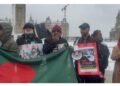
Ottawa observed people of East Pakistani descent taking to the streets across Canada as soon as they learned of the sudden, covert military crackdown. There were reports of clashes between groups condemning the atrocities committed by the West Pakistani army and those viewing the crackdown as a necessary evil to restore law and order. As the gruesome details of the massacre and widespread destruction emerged, the Canadian media began playing a larger role in raising awareness and shaping public opinion in favor of an independent Bangladesh.
Throughout the nine long months of the struggle for Bangladesh’s independence, Canada maintained its stance of “neutrality,” although there were clearly occasions when it became involved both actively and passively. Once again, there were instances when Canada’s actions, or lack thereof, could not be explained in a straightforward manner, as understanding the Canadian perspective on the Pakistan-Bangladesh conflict required examining a range of related questions.
This book argues that, because Canada lacked strong strategic interests in Pakistan or India, it maintained a sympathetic understanding of the two main parties involved: the military government of President Yahya and the democratic aspirations of the Pakistani people, represented by Sheikh Mujibur Rahman, the prime minister-elect. Drawing on both pro-Pakistani and pro-Bangladeshi sources, Canada gained insight into the psychological and emotional dimensions of the conflict, driven by economic inequality and political discrimination in Pakistan. Canada recognized that the ideas of “freedom” and “future” remained prominent in the minds of both military leaders and politicians in Pakistan. With considerable unease, Ottawa chose to observe how the unfolding events affected the fate of the Bengalis. Ultimately, viewing the suffering of the Bengalis as a powerful story of human hardship and a denial of democratic rights in Pakistan, Canada decided not to be merely a bystander but to actively get involved, all while maintaining its foreign policy of “non-intervention.”
Mustafa Chowdhury has authored the following books: ’71-er Judhoshishu: Obidito Itihash; UNCONDITIONAL LOVE: Story of 1971 War Babies; Picking Up the Pieces: 1971 War Babies’ Odyssey from Bangladesh to Canada.
E-mail: Mustafa.chowdhury49@gmail.com
Cell number: 1 613 799 0503 (WhatsApp and Viber)